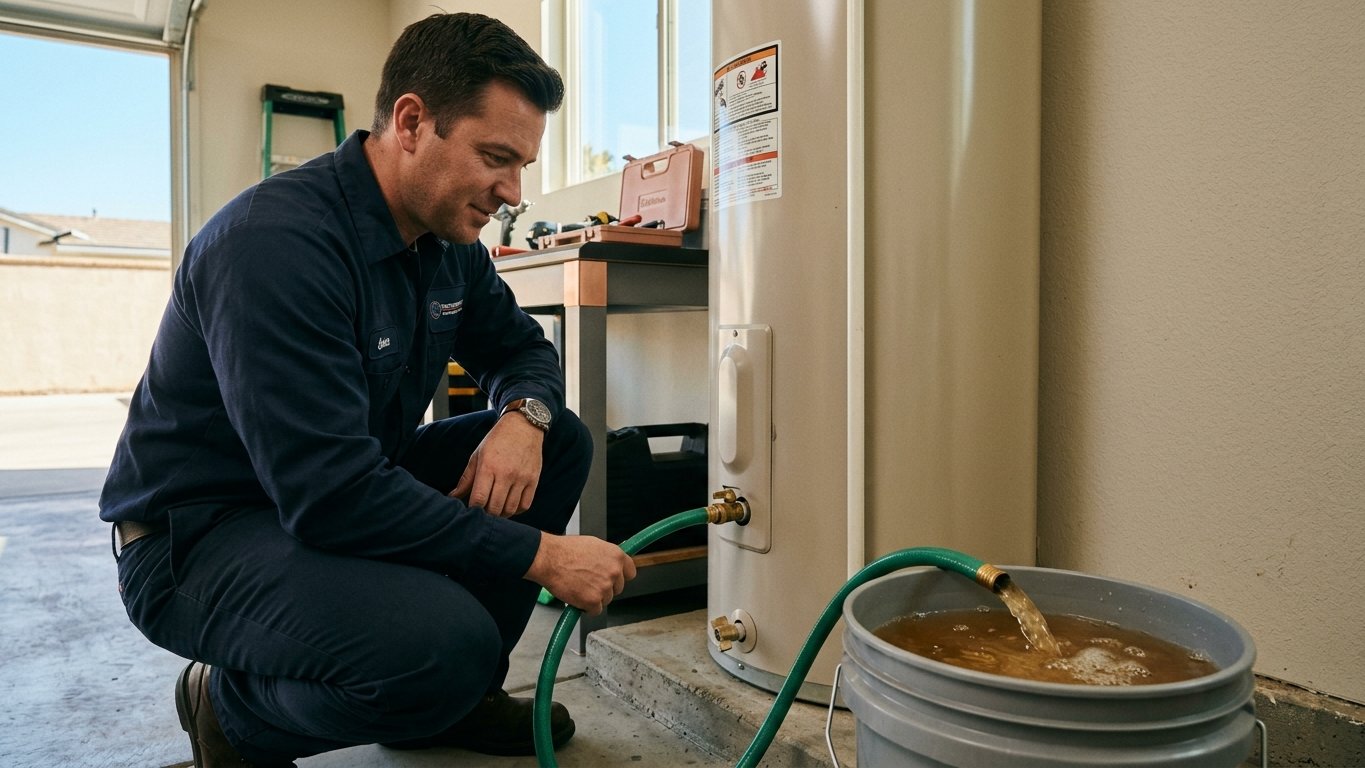
Hard water is the local villain
Every gallon heated in San Diego drops a little calcium and magnesium. In a tank it settles as sediment, hardens into scale, and forces the burner to heat through a crust — stealing capacity and years. In a tankless unit it coats the heat exchanger and chokes flow. A maintenance schedule a soft-water city could skip is simply not optional here.
What a real maintenance visit includes
A drained flush of the sediment, a look at the anode rod — the sacrificial part that corrodes so the tank does not — a test of the temperature-and-pressure relief valve, and a check of the burner or elements and temperature setting. For tankless, the equivalent is a circulated descaling solution. Fifteen-minute "flushes" that skip the anode and the T&P valve are theater.
- Tank flush. Drains sediment off the tank floor before it scales over
- Anode rod. Inspected and replaced when depleted — it is the tank's lifespan
- T&P valve. Tested to confirm the safety release actually releases
- Tankless descale. Solution circulated through the heat exchanger annually
The payoff in years, not vibes
Tanks here that never see a flush land at the short end of the 8-to-12-year range; maintained units reach the long end, and a fresh anode rod can push past it. On a tankless unit, annual descaling protects both performance and the manufacturer warranty. Against the price of an early replacement, an annual service visit is rounding error.